

savings
benchmarked
accuracy
target
p99 benchmark
What is an AI Control Plane —
and How It Differs from an AI Gateway.
AI Control Plane
The software layer that governs how every AI request moves through your infrastructure — from input policy and capability qualification, through model selection and routing, to response validation and audit. Governs the entire execution lifecycle, not just routing.
AI Gateway
Primarily mediates and manages AI traffic between applications and model providers. Modern gateways also increasingly provide guardrails, policy controls, observability, PII protection, and spend controls. An AI control plane extends the architectural scope further toward lifecycle-wide governance, session-aware policy enforcement, response validation, and governance provenance.
CARDIAC-PURR AI Control Plane
The enterprise implementation of this architecture — governing request routing, policy enforcement, provider selection, response validation, automatic failover, cost control, and execution auditability across multi-provider AI infrastructure. Its built-in LLM Router is one capability within the broader control plane.
AI Governance at
Production Scale
CARDIAC-PURR AI Control Plane is a session-aware governance layer for AI infrastructure — it inspects, routes, and validates every AI interaction before and after model execution, so nothing reaches your users unchecked.
Here's how it works, end to end:
Every Enterprise Running AI
Faces the Same Six Gaps.
Most organisations treat AI infrastructure as a procurement problem — buy API credits, pick a model, hope it works. The result is uncontrolled cost, ungoverned risk, and zero operational visibility.
No Cost Visibility
AI spend is invisible until the invoice arrives. No per-request attribution, no team-level breakdown, no mechanism to enforce limits before they're breached.
All Traffic Goes to the Most Expensive Model
Simple queries get routed to large, premium models by default. Most production AI traffic doesn't need them — but there's no system to route appropriately.
No Governance Between Model and User
Outputs go directly from the model to your users. No confidence checks. No policy enforcement. No blocking of unsafe or low-quality responses before they reach production.
Zero Operational Visibility
When a model degrades mid-session, there's no alerting, no fallback, and no audit trail. Incidents are discovered after the fact — if at all.
Single-Provider Lock-In
One provider going down takes down your entire AI stack. Switching requires code changes. Comparing providers on live traffic is effectively impossible.
No Audit Trail for Regulated Sectors
Regulated industries need to know which model responded, why, what policy checks were applied, and what the cost was — per request, end-to-end, reviewable.
What Your Governance Layer
Actually Does.
A router makes one decision: which model handles this request. A governance plane makes that decision and stands between the model and your user.
Bad or unsafe responses reaching users
Before any response leaves the system, it passes through policy checks, confidence thresholds, and severity-based blocking. When the system isn't confident enough, it escalates to a stronger model — a cascade, not a failure.
Prompt injection and adversarial inputs
Queries that attempt to override system instructions are detected and routed to minimum-capability handling, so an injection attempt can't escalate its own privileges.
Unnecessary exposure of sensitive data
Personal or sensitive information is not passed to third-party providers beyond what's operationally necessary — enforced before the routing decision, not after.
Silent infrastructure failure
If a provider degrades or goes down mid-session, failover happens automatically with deterministic fallback chains rather than an unhandled error.
Three Layers.
One Control Surface.
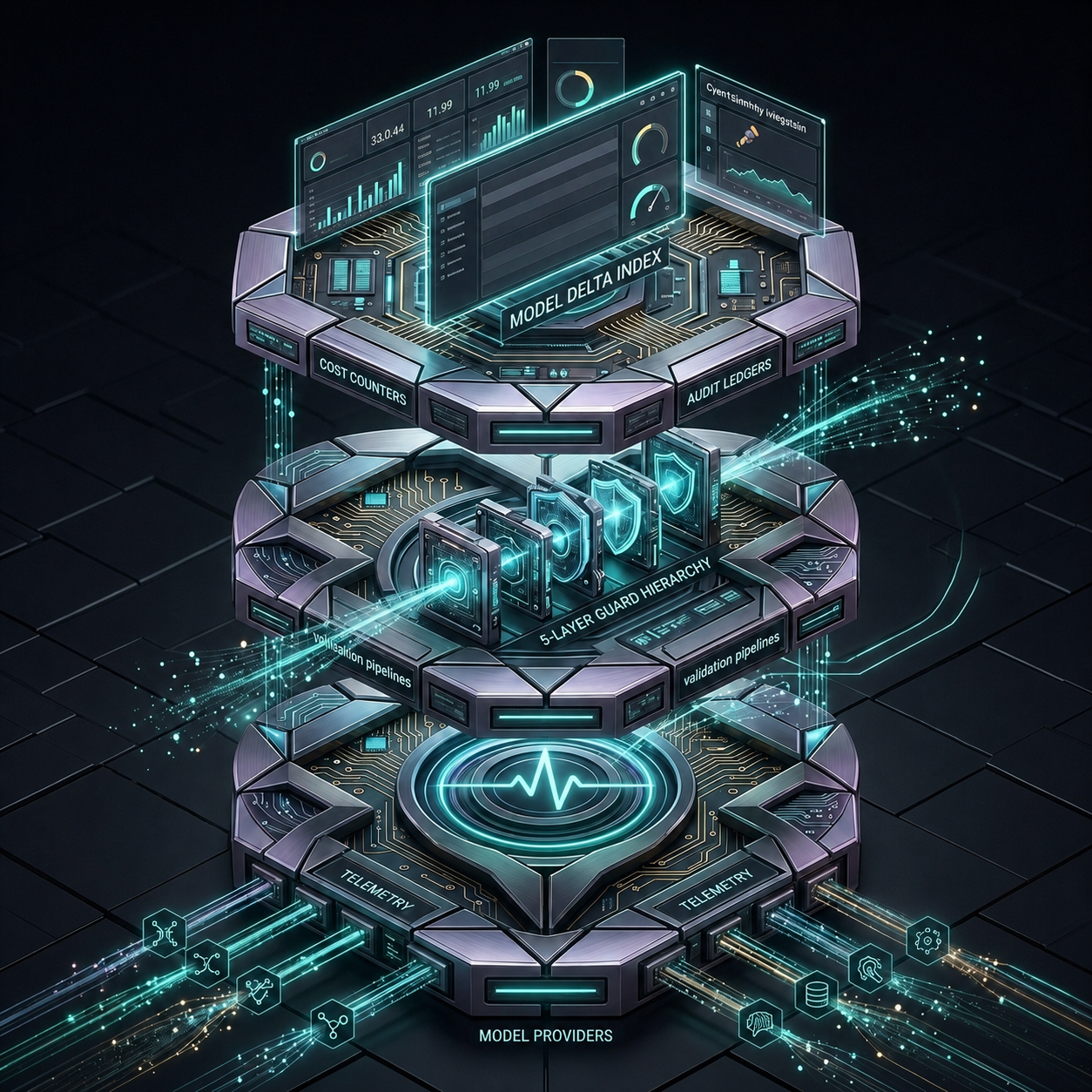
Intelligent Routing & Optimisation
Evaluates task complexity, latency requirements, provider availability, model capability, pricing, and execution context — then dynamically selects the most efficient model for every request.
Risk Prevention & Governance Engine
A multi-stage governance system enforcing policy constraints, model eligibility rules, confidence thresholds, and validation logic before any response reaches the user.
Financial Optimisation & Observability
Every routing decision is measured, costed, and attributed via the Model Delta Index — our per-request cost and quality scoring system — producing procurement-grade audit trails, not a black-box expense.
Production-Scale Reliability
Built for environments where downtime is measured in millions. Bounded operational behaviour under all failure modes.
Multi-Provider.
Zero Lock-In.
Route by capability, cost, latency, or compliance requirements — switch providers without changing your application code.
| Provider | Description |
|---|---|
| Frontier Models | |
| A Claude | Anthropic — Advanced reasoning, long context, safety-focused |
| O GPT | OpenAI — Broad capability, extensive fine-tuning ecosystem |
| G Gemini | Google — Multimodal, native integration with Google Cloud |
| X Mistral | Mistral AI — European, cost-efficient, open-weight models |
| H Cohere | Cohere — Enterprise embeddings, multilingual, RAG-optimised |
| D DeepSeek | DeepSeek — High-performance reasoning at low inference cost |
| Llama | Meta — Open weights, self-hostable, no API dependency |
| K Grok | xAI — Real-time data integration, conversational reasoning |
| Enterprise & Self-Hosted | |
| Z Azure OpenAI | Microsoft — Same underlying models as OpenAI; enterprise compliance, regional data residency |
| + Custom | Private endpoints, on-premise models, proprietary fine-tunes |
Provider availability, capability matrices, and deployment requirements are documented per environment during technical evaluation.
Your Agents Route Through
the Same Control Plane.
Agent frameworks make their own tool-calling and planning decisions — but every model call they issue still needs routing, governance, and cost control. CARDIAC-PURR sits between the framework and the model providers, qualifying each request against capability requirements and applying the same tier routing used across the platform.
Framework → Capability Qualification → Tier Routing (auto / small / medium / large) → Provider
Requests are qualified against tracked capabilities — tool calls, structured output, reasoning, context window, streaming, and vision — before a tier is selected. Validated across all seven frameworks in a 350-request factual-QA benchmark (August 12, 2026, small-tier routing).
Explore Agentic Architecture →From Request to Response,
Governed at Every Step.
Request Intake
Through the platform API exactly as to any single provider. No code changes, no SDK migration.
Intelligent Routing
Evaluated against agreed routing inputs such as task context, policy constraints, provider availability, capability, and operational requirements.
Governance Enforcement
Policy constraints checked, confidence thresholds validated, unsafe outputs blocked, fallback chains triggered if needed. Every decision logged.
Response & Audit
Full provenance returned: model used, why, cost, governance checks applied. Complete traceability for every request.
Film
The Control Plane, Visualised.
Routing decisions, latency control, cost governance — from request to response.
CARDIAC-PURR AI Control Plane
within the Technology Family.
CARDIAC-PURR is the software-control technology family developed by 2info LLC CARDIAC-PURR AI Control Plane is the enterprise AI execution and governance product within that family — a control plane that sits above your AI stack, mediating every request and response across your model providers. CARDIAC-PURR Thermal and PURR SHIELD address GPU thermal stability and memory resilience respectively and do not share the AI Control Plane’s routing architecture. All three products are developed and owned by 2info LLC
AI Control Plane,
Gateway & Router — Answered.
An AI control plane is the software layer that governs how AI requests move through enterprise infrastructure — from input policy enforcement and capability qualification, through model selection and provider routing, to response validation, cost control, and execution audit. While an AI gateway primarily mediates and manages AI traffic, a control plane governs the broader execution lifecycle before, during, and after every model call. The term comes from network and cloud architecture, where the control plane governs how traffic is directed — distinct from the data plane, which carries it.
An AI gateway is primarily concerned with mediating and managing AI traffic — routing requests to model providers, handling failover, caching, and provider abstraction. Modern gateways also increasingly include guardrails, policy controls, observability, PII protection, spend controls, and audit logging. An AI control plane extends the scope toward lifecycle-wide execution governance: deterministic input policy enforcement before routing, session-aware context across interactions, response validation before delivery, immutable governance provenance, and organisational controls across providers and agent frameworks. The distinction is one of architectural scope rather than a binary capability difference.
An LLM router selects which model or provider handles a request — based on cost, latency, capability, or availability. It is one decision: execution destination. An AI control plane contains an LLM router as one capability, surrounded by input policy enforcement, capability qualification, response validation, governance, cost optimisation, and audit provenance. In CARDIAC-PURR AI Control Plane, the LLM Router is the routing engine within the broader control plane — not the product itself.
A control plane becomes relevant when routing alone is not sufficient — when an organisation must enforce deterministic policy at runtime, validate responses before they reach users, maintain session-level context, produce governance evidence for audit or regulatory workflows, restrict which models are eligible for particular tasks, or govern AI behaviour consistently across agent frameworks and multiple providers. Common triggers include operating under applicable AI regulation, running AI in regulated industries, deploying autonomous agents in production, requiring cost governance across providers, or needing operational auditability beyond access logs. An AI gateway is often sufficient for prototyping, access standardisation, and basic multi-provider failover.
No. PURR SHIELD is a separate memory-resilience technology operating at the GPU memory-protection layer, within the CARDIAC-PURR technology family. The LLM Router is the model-routing capability inside CARDIAC-PURR AI Control Plane, operating above the AI stack to select the appropriate model and provider for each request.
Layer 1 (Intelligent Routing & Optimisation) evaluates task complexity, latency, provider availability, capability, pricing, and context to pick the most efficient model per request, with cascade recovery and fallback execution if a provider degrades.
No. The platform requires no training at all — this is by design and is a deliberate part of how it's differentiated from competitors. Classification uses deterministic rule-based logic rather than a trained model, per our own Article 10 compliance documentation.
Routing latency depends on the implementation, configured checks, network path, and provider response behavior. It should be measured in the customer's own environment.
Provider support should be confirmed for the intended deployment. The architecture is presented as a control-plane approach for working across model providers, not as a public compatibility guarantee.
Routing accuracy should be evaluated against an agreed test set and method. Published numbers should only be used after the evidence is reviewed.
Yes — confirmed at three real, independent layers: organisation-level budget limits, organisation-level rate limits, and a model allowlist. This is enforcement scoped per organisation, not a single global policy applied identically to every customer.
No. Most AI gateways focus on access and interoperability — getting a request to a model and back. CARDIAC-PURR AI Control Plane is built around deterministic execution governance, runtime risk prevention, financial optimisation, and operational control. Its LLM Router handles model and provider selection as one capability within the broader control plane. Routing is the front door; governance is everything that happens before a response is allowed to reach production.
Layer 1 (Intelligent Routing & Optimisation) evaluates task complexity, latency, provider availability, capability, pricing, and context to pick the most efficient model per request, with cascade recovery and fallback execution if a provider degrades. Layer 2 (Risk Prevention & Governance Engine) is a multi-stage, 5-layer guard hierarchy enforcing policy constraints, model eligibility, confidence thresholds, and validation logic before a response reaches the user. Layer 3 (Financial Optimisation & Observability) measures every routing decision, provider substitution, and cost through the Model Delta Index (MDI), giving real-time cost visibility and procurement-grade reporting.
Any cost-accounting or routing-reporting method should be documented for the specific deployment and reviewed against the customer's own provider invoices before claims are made.
One line of code: swap base_url to https://api.cardiac-purr.com/v1. Compatible with the standard OpenAI Python SDK via the base-URL swap. Everything else stays the same.
Confirmed — the /v1/route/preview dry-run endpoint returns a routing decision with no billing or audit side effects.
Fixed, not customer-configurable. The primary provider is whatever the router already selected for that request; the fallback order beyond that is derived automatically from the platform's own provider registry at call time — deterministic, but not a preference list a customer can set.
An LLM router evaluates each request and selects an appropriate model, model tier, or provider based on factors such as task requirements, capability, policy, cost, latency, and availability. In CARDIAC-PURR, the LLM Router is a capability within the broader AI Control Plane, which also applies governance, response validation, failover, observability, and auditability across the execution lifecycle — so routing is one governed step rather than the whole product.
An LLM router can reduce unnecessary model spend by directing requests to an appropriate model, model tier, or provider rather than using the most expensive option for every workload. CARDIAC-PURR measures routing and cost outcomes per request. Published benchmark results ranged from 30.9% to 88.3% savings depending on provider pricing structure and workload composition, and should not be interpreted as a universal savings guarantee — results vary by deployment.
A traditional API gateway manages general application traffic — authentication, access control, rate limiting, and routing between services. An AI gateway is designed specifically for traffic between applications and AI models, and may add model and provider routing, AI-specific observability, prompt controls, spend management, caching, guardrails, and related governance features. An AI Control Plane extends beyond traffic mediation toward lifecycle-wide execution governance, validation, provenance, and policy control across providers and agent frameworks.
An LLM router selects a model or provider for a given request — it makes one decision: execution destination. An AI gateway mediates and manages the broader flow of AI traffic, typically adding provider abstraction, failover, rate limiting, caching, cost tracking, and increasingly policy and observability features on top of routing. In practice, the boundary between a sophisticated LLM router and a lightweight AI gateway is often a matter of implementation depth rather than a hard architectural distinction. In CARDIAC-PURR AI Control Plane, the LLM Router is the routing module within the broader control plane — responsible for model and provider selection as one step in the governed execution pipeline.
No — though the two are complementary. AI governance describes the policies, processes, accountability frameworks, and organisational controls that determine how AI systems are developed, deployed, and monitored. An AI control plane is runtime infrastructure that enforces those policies during execution and records the resulting decisions as governance evidence. In short: governance defines the rules; the control plane enforces them at execution time and produces the audit record.
An MCP (Model Context Protocol) gateway primarily governs the connection between AI agents and external tools or MCP servers — managing access, permissions, and context for agent-tool interactions. An AI control plane governs a broader execution scope that can include model selection, provider routing, input policy enforcement, response validation, cost control, observability, and auditability across both direct application calls and agentic workflows. The two can coexist in an architecture: an MCP gateway handling agent-tool access while a control plane governs the model execution layer above it.
Not necessarily. They can exist as separate architectural layers, or the capabilities of both can be incorporated into a single control-plane implementation. The right architecture depends on the organisation's routing requirements, governance obligations, security posture, observability needs, and compliance context. CARDIAC-PURR AI Control Plane is designed to serve as the single governed execution layer above model providers — covering routing, policy, validation, and auditability without requiring a separate gateway in front of it.
No. A control plane governs both direct application-to-model requests and agentic workflows through the same execution layer. Autonomous agents increase the importance of runtime policy, provenance, and auditability — because agent systems make many model calls with less human review between steps — but agent usage is not a requirement. Many enterprise teams adopt a control plane initially for governed multi-provider routing and cost optimisation on standard application requests, then extend the same layer to cover agent workloads as those systems mature. See Agentic Framework Support for integration details.
Common triggers include: operating across multiple AI providers or models and needing consistent governance above them; requirements for deterministic runtime policy enforcement; model eligibility restrictions by task, user, or organisational unit; response validation before output reaches end users; cost governance and verified savings measurement across providers; audit or record-keeping obligations under applicable AI regulation or internal compliance requirements; deployment of autonomous agents in production workflows; or enterprise observability requirements beyond provider-level access logs. None of these individually mandates a control plane — the appropriate architecture depends on the specific requirements. For a detailed look at deployment scenarios, see Use Cases and Compliance.
Ready to Govern Your AI Infrastructure?
Technical documentation and a scoped evaluation plan are provided at the start of every engagement.